

Verified Carbon Data Driving Down Emissions
The Background
- Date
- 2021-2026
Storm Geomatics support clients whose core mission is to understand, manage, and reduce flood risk.
As the impacts of climate change intensify, these clients are increasingly aware that flooding is intrinsically linked to greenhouse gas emissions across entire supply chains.
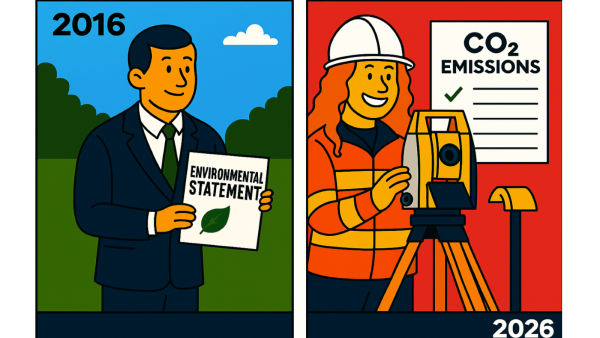
The evolution of carbon reporting from glossy brochures to verified, data‑driven carbon management aligned with ISO 14064‑1.
Main Objective
The primary objective of Storm Geomatics’ carbon accounting and ISO 14064‑1 verification was to establish a robust, verified carbon footprint that could withstand increasing scrutiny from clients and their procurement teams.
Carbon accounting enables Storm Geomatics to:
- Clearly understand what makes up our greenhouse gas emissions
- Identify hotspots across operations and the wider supply chain
- Use data to inform strategic decisions and operational change, within Scopes 1,2 & 3
- Demonstrate credible data through independent verification
Climate change is a driver for flood risk management. Our clients know this and their awareness is now reflected in procurement processes, where emissions data is no longer optional but fundamental.
The Challenge
-
Challenge to reduce carbon emission.
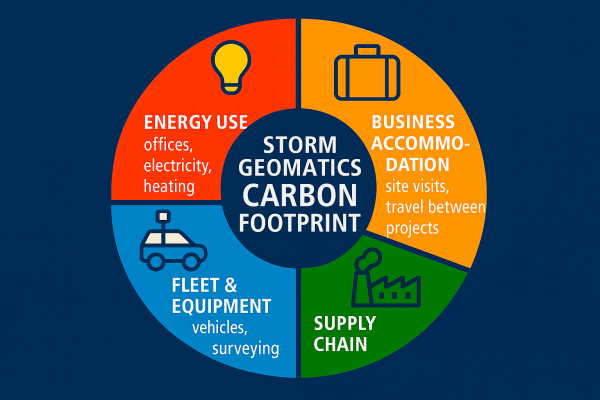
Our main challenge to reduce our carbon emissions was to firstly understand where they were in our business. From there it was then about taking the largest items first and thinking of ways of reducing our carbon emissions with each item. It was relatively easy to reduce our own emissions and to plan this over a period so that we continuously reduce, but trying to persuade our suppliers to reduce theirs has been largely unsuccessful to date. This is important, as our suppliers made up 84% of our total carbon in the reporting year 2024/25. Our carbon verification report is available here.
-
Challenge to educate our clients as to why this is beneficial to them.
Most of our clients have targets to reduce their own greenhouse gas emissions, and like us, they start with the emissions that they have control of (scope 1 & 2).
But where do our clients start with scope 3’s (their suppliers) which are 100% out of their control?
Carbon emissions for scope 3’s are mostly calculated by multiplying the amount you spend in £ by the appropriate DEFRA emission factor for the goods/services you are buying. Because we are accurately calculating our emissions and have them verified by a UKAS accredited company to ISO14064, we can provide our own credible emission factor per £ of service to our customers.
A Case Example
As an example of how this has worked, Mike Hopkins recently had a meeting with a client who said they were using a Defra emission factor of 0.151 kgCo2e for every £ of geospatial service they buy.
Storm produces geospatial services at a verified emission factor of 0.1135 kgCo2e which was measured in the year 2024/25. Because this was verified to ISO14064 the Sustainability Manager was able to use this figure for our services to their company.
As a result our client contacted us to say; that by doing this they had taken 52 tCo2e off their carbon account for that year. They also said that this is exactly what they are looking for from all their suppliers, and would introduce more questions in the Sustainability sections of their tenders to allow higher scores for companies that can produce verified figures.
Storm are now actively working with our suppliers to produce verified carbon emissions, something we have requested for a while…watch this space for more carbon savings from Storm Geomatics.
Carbon accounting at Storm Geomatics is not a one-off exercise. It is a continual improvement process, using verified data to:
- Track performance over time
- Identify opportunities to reduce emissions across the supply chain
- Support informed pivoting of operations and services
- Maintain our position within climate-conscious supply chains
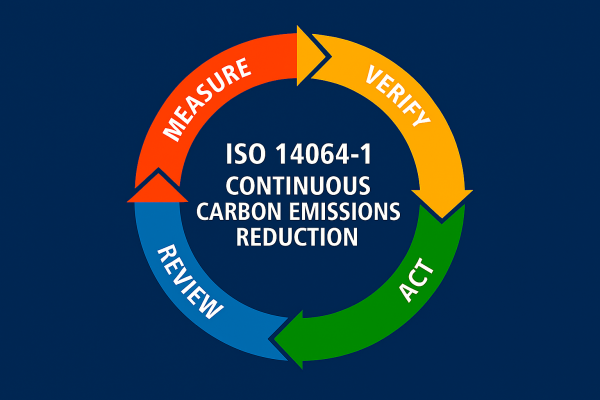
Storm Geomatics’ ISO 14064‑1 continuous improvement cycle, using verified carbon data to measure, review and reduce emissions year on year.
Recent News
Biodiversity Gains Delivered with Data
Geospatial Data Powers Asset Management